
Process for Mountainous
Written by Julia Kuo
Pub. October 27, 2026
Purchase from Bookshop
My daughter Lana was just a few months old when I was finishing up the manuscript of Mountainous. Every week I delighted in her new developments, and every week I mourned the loss of who she was the week before. I’ve often heard other parents marvel at watching their children grow and develop, but experiencing it myself has been the most unexpected adventure.
It’s a different kind of adventure than the type I’ve been chasing for the past decade: the snowy and rocky type. I’ve eagerly measured my own growth in horizontal miles and vertical feet, but also in physical and mental strength. Sometimes this progression was explosive, and sometimes it stagnated or grew only in spurts. It only took me a year to learn how to rock climb, but it took me five more to manage my fear of falling.
My daughter and I are growing and aging on different tracks, just two creatures in a world full of change both big and small. The more time I spend outside, the more I see the landscape as a third character in our adventures. What will the mountain do today? How will the trail look after a year away? And what is the likelihood of rockfall along this route?
My new book Mountainous is a product of all of these thoughts. Change is inevitable for all inhabitants of this world, even the biggest of mountains. These dynamic mountain environments are subject to forces that we are all too aware of, such as earthquakes and volcanoes. What I found even more intriguing is the change that their sheer size seems to generate, from creating their own weather systems to erosion via the weight of their own glaciers.
The dreamiest spread of the book imagines the girl and her mom moving, large like mountains, through the landscape of Mt. Roraima in South America. I hope readers can picture themselves being like a mountain on days they are constantly in motion, humming and swaying. Or on other days they can be just like a mountain that is slow and calm, stretching out into the horizon.
I spent a lot of time thinking about which mountains to illustrate and write about in this book. I wanted to make sure there was variety: old, low mountains (the Appalachians) as well as tall mountains that are still growing (Sagarmatha/Everest). I included mountains that sit in famous alpine areas (Ama Dablam, Matterhorn) and mountains that stand on their own (Mt. Kilimanjaro). I wanted visual variety, too, so in addition to the stereotypical triangle mountain shape, I made sure to include low and sloped mountains, flat-topped and caved-in mountains, and jagged ridgelines. I also included mountains that I have personal attachments to, such as Tahoma/Mt. Rainier and Lawetlat’la/Mt. St. Helens.
We spent quite a lot of time considering whether or not to label each mountain by name, height, or origin where they appeared in the book. In the end we decided to wait until the reader got to the back matter (at the very end of the book). Our thinking was that the two levels of information on each page, the simple narrative and the sidebar, were already enough to digest as you moved through the book, and that these labels didn’t necessarily further any of that information.
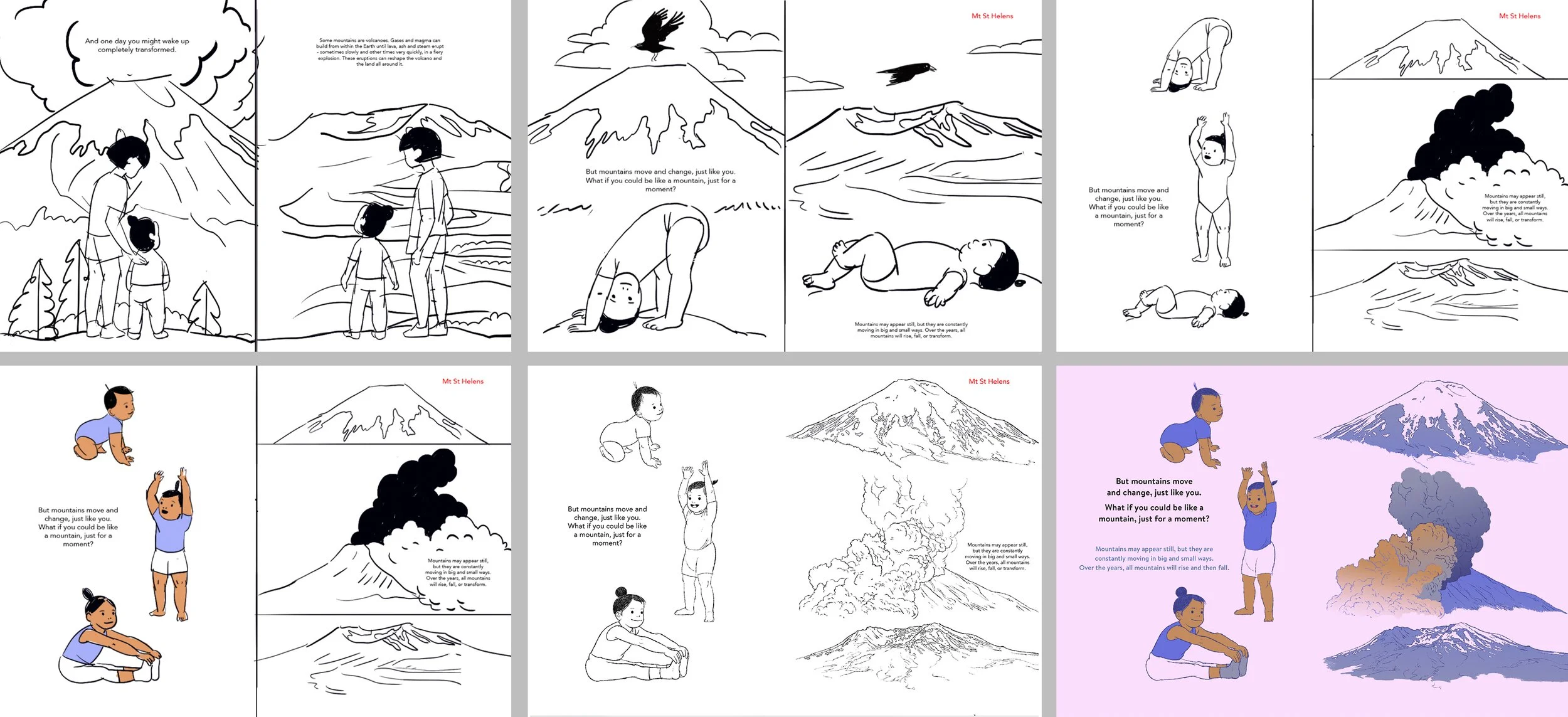
The 1980 eruption of Lawetlat’la/Mt. St. Helens was such a significant chapter in US volcanic history and perhaps one of the most dramatic illustrations of change that a mountain can undergo. Eager to learn more, I signed up for a volcano naturalist class with the Mt. St. Helens Institute in 2023, just when I was beginning to write Mountainous. We heard from the Cowlitz tribe, listened to first-hand accounts of the eruption, and learned from geologists and historians. The class ended with a trip to explore Ape Cave and some of the mountain’s smaller lava tubes!
Mountainous is all about pairing the big and small change mountains go through with human change. It might have been natural to pair the violent eruption with some type of decline or death, but I wanted to find another example of human change that is dramatic and transformative. After some experimentation, I paired the eruption with the relatively big changes a toddler goes through in the first couple years of life. My daughter was just learning to crawl when I was working on the sketches. I finished the book right around the time that she started walking. Dramatic and transformative, indeed!
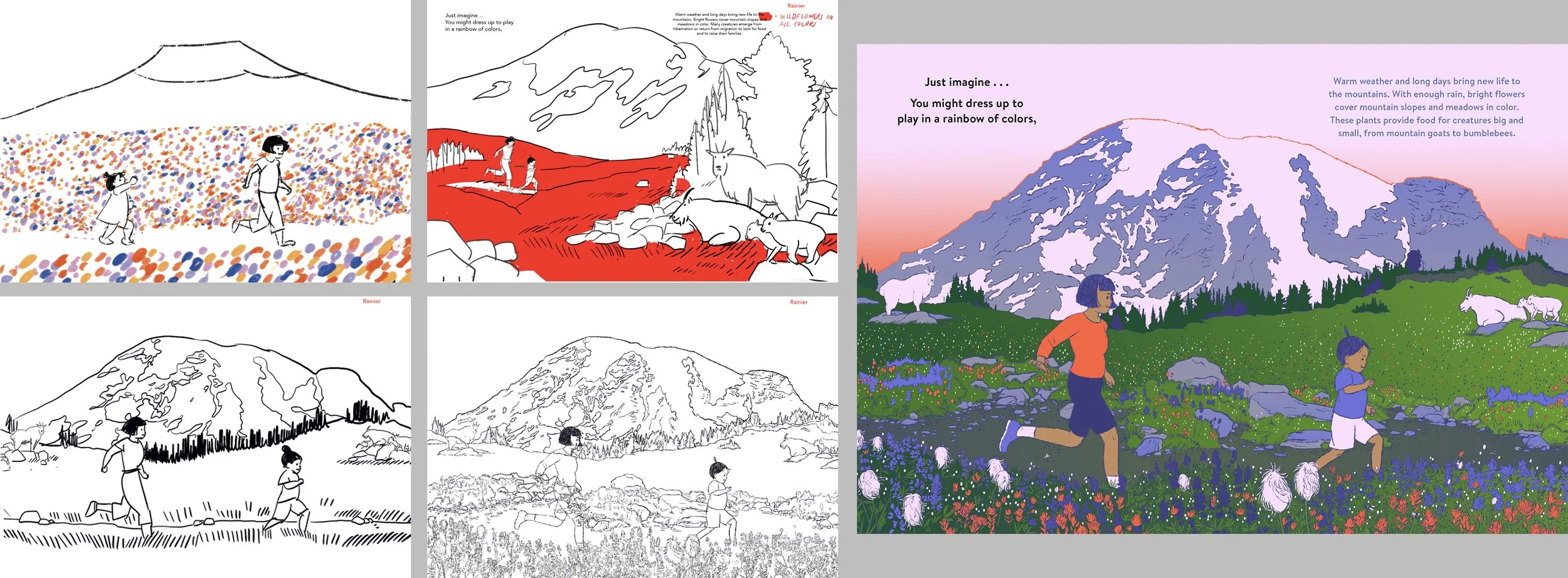
Perhaps my closest connection to mountains is with Tahoma/Mt. Rainier. I have had wildly different experiences on these mountain slopes, from climbing past seracs in the middle of the night to pushing a stroller around Paradise visitor center. It would be hard to condense my experiences of the mountain into one illustration. Similarly, there is so much to say about mountain ecosystems and change that it’s hard to distill any one mountain into one thought or sentence.
We should talk about the many different ways to address this mountain: Tahoma, Tacoma, and Takhoma - the names used for centuries by the indigenous tribes who call this area home. The name Mt. Rainier is only a couple centuries old - a blink of an eye for a mountain - and it was named by George Vancouver for his friend.
We should choose to write about the retreating snow line, about how the snow has been disappearing earlier every year and the crevasses have become exposed at an earlier date almost every summer.
For this particular spread, I chose to illustrate and write about the wildflowers. Visitors flock to Mt. Rainier National Park during the summer months to see the riot of colors that bloom all over its slopes. The accessibility of visitor centers like Paradise make it possible for all types of people, with different mobility and ages, to experience the wonder of an alpine summer. I believe that access is a hugely important part of our relationship to nature, as to protect a place you must first know and love it.
The endpapers depict a fictional scene in a real place. This is a Milk Pond, a hot spring on Yang Ming Mountain in Taiwan. There are many types of geothermal activity, but the book only includes the catastrophic eruption of Mt. St. Helens and the frequent river-like lava flows on Mauna Loa. We don’t mention other types of activity such as geysers, hot springs, and fumaroles. The endpapers are typically the last original art to be created for the book (after the cover and the title page) and so this was my last effort to throw in one last bit of variety!
There are plenty of Taiwanese hot springs that tourists can bathe in, but Milk Pond is actually not one of them as it is off limits to enter. The reason I chose this particular location is because of the lushness of the subtropical forest all around. It is a setting that feels very representative of Taiwan and one that Northern American readers might not associate with a hot spring. So this is an imaginative exercise of a mom and her daughter playing in the hot spring when they are young, and then enjoying it again together, decades later. What more could a parent wish for?
There is so much we can say about the way mountains and their ecosystems change through time. There is even more we can say about human growth and decline. I know we have only scratched the surface of some very large topics, but I hope you’ll enjoy thinking about it as time passes - whether that is at a snail’s pace or in the blink of an eye!
Other spreads that reflect personal experiences that I didn’t mention above:
* I have gone dogsledding in Banff National Park (although in this book, we show the mother and child dogsledding around Mt. Denali)
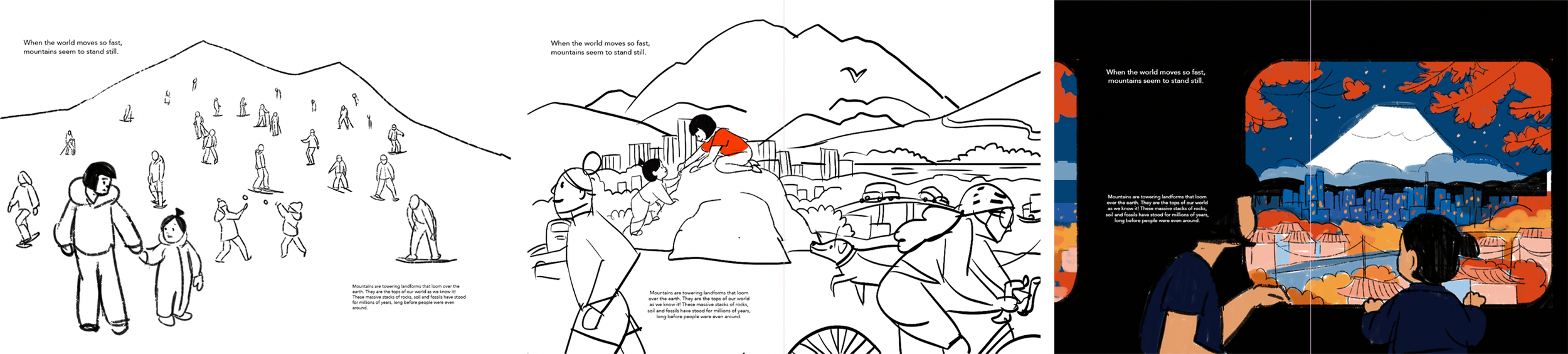
* We visited Japan while I was writing the book and saw our first glimpse of Mt. Fuji via a train, just like in the book!
* The volcano spread depicts Hawaii Volcanoes National Park on the Big Island. Years ago I biked to this very lava flow and learned that one could also watch it from boat in the water, which is how I ended up depicting the POV of the mother and child!